Why Most AI Voice Agents Fail in Arabic
A customer calls in Lebanese dialect, the AI asks them to repeat, then answers in stiff formal Arabic. Here's why most AI voice agents break down in real Arabic conversations — and what it takes to build one that actually works in this region.
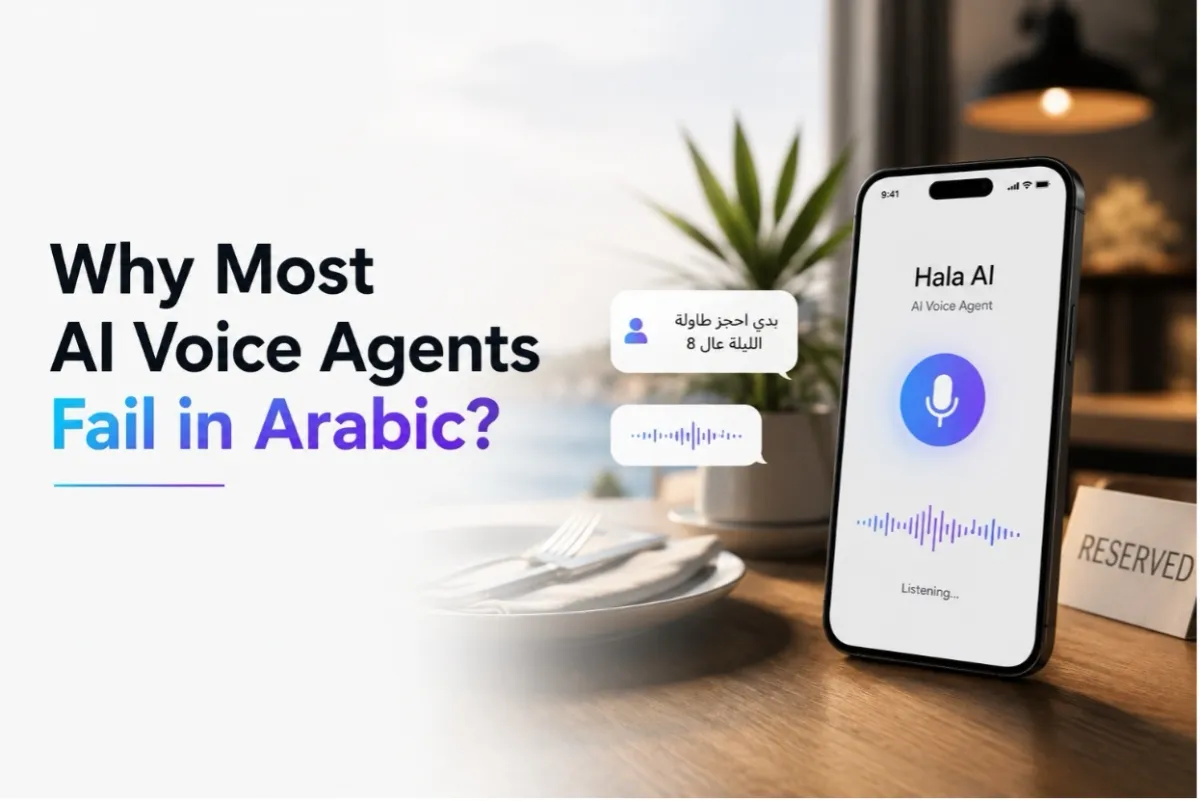

A customer calls. They ask in Lebanese Arabic dialect. The AI asks them to repeat themselves. They do. It still doesn't quite get it. Then it responds in this stiff, formal Arabic that sounds like it was lifted out of a government document. The caller hangs up.
That's not a hypothetical. That's what happens every day across Lebanon and the MENA region when businesses deploy AI voice agents that weren't actually built for this part of the world.
The "Supports Arabic" Problem
When AI vendors say their product "supports Arabic," they usually mean something very specific: the system can process Modern Standard Arabic — the formal, standardized variety used in newspapers, official documents, and TV news broadcasts. What they don't say is that virtually nobody speaks Modern Standard Arabic in an actual conversation.
Differentiating Arabic accents
The Arabic your customers use when they call is casual. It's Lebanese, or Gulf, or Egyptian, or Saudi Arabic. These aren't just accents of the same language. They're genuinely distinct varieties, with different vocabulary, different pronunciations, and in some cases different grammar. An AI trained on formal Arabic news broadcasts is about as prepared for a Lebanese caller as a system trained on English would be for a conversation in France.
Arabic Is Not One Language
This is the core misunderstanding behind most failed Arabic AI deployments. Arabic has over 30 distinct dialects, and the differences between them can be dramatic.
A Moroccan speaker and a Gulf Arabic speaker might genuinely struggle to understand each other. Lebanese Arabic is so heavily influenced by French and English that switching languages mid-sentence is completely normal. Egyptian Arabic is the most widely understood variety in the region thanks to decades of film and TV, but it's still distinct from the dialects spoken in Lebanon, Syria, Jordan, and Palestine. Gulf Arabic varies noticeably between Saudi, Emirati, Kuwaiti, and Qatari speakers.
An AI agent that handles one variety reasonably well may fail completely with another. And a system trained primarily on Modern Standard Arabic handles none of them well in natural conversation.
The Training Data Problem Nobody Puts in Their Marketing
The vast majority of high-quality Arabic text data used to train AI systems comes from formal sources — news websites, government documents, Wikipedia entries, academic papers. All written in Modern Standard Arabic. It's abundant, it's well-structured, and it sounds nothing like how anyone in Lebanon or the MENA region speaks on the phone.
Informal Arabic dialect data — the kind you'd need to build an AI that genuinely understands conversational speech — is genuinely hard to collect. It requires recording real conversations, transcribing them accurately, and annotating them so a system can learn from them. When you multiply that across 30+ distinct dialects, the task becomes enormous. English AI has had decades of serious investment in exactly this kind of conversational data. Arabic AI, in most commercial systems, is still largely built on formal written text.
The gap between what these systems know and how people actually talk is significant. And your customers feel it immediately.
How People in This Region Actually Communicate
In Lebanon, mixing Arabic, French, and English in a single sentence is just how people talk. A caller might say something completely natural like: "bade table for six, 3al eight, w comment est le parking?" One sentence. Three languages. Zero confusion for the Lebanese person saying it — and complete confusion for most AI systems.
In the MENA region, any AI voice agent that can only handle pure Arabic — let alone only formal Arabic — is already working at a serious disadvantage in this market.
Why Restaurants and Hospitality Feel This the Most
The failure of generic Arabic AI shows up most visibly in restaurants, cafes, and venues. And the reasons stack on top of each other.
- Dialect diversity. A restaurant in Beirut might get calls from Lebanese locals, visitors from the Gulf, and Egyptian guests, all in the same evening, all speaking different Arabic varieties.
- Noise. A full kitchen, a Friday crowd, a room watching the match — these environments are hard even for humans to work in. An AI already struggling with dialects in quiet conditions will fall apart with background noise added.
- People aren't asking simple yes/no questions. They want to know about tonight's availability, the game-day menu, private event pricing, whether argileh is included, what time the kitchen closes. That's nuanced intent, in dialect Arabic, in a noisy room. Generic AI was never built for that.
Every one of these layers makes the others worse. The result is an AI that frustrates callers and quietly costs restaurants bookings they never even knew they missed.
What Actually Works
An Arabic AI voice agent that genuinely works in this market has to start from a completely different place than an English AI with Arabic added on. It needs to be trained on real conversational speech data, not just formal text — because that's how people here actually communicate. It needs to understand regional vocabulary, local idioms, and the cultural norms around how service interactions are expected to go in the Arab world.
This is exactly the gap Hala AI was built to fill.
Hala AI is an Arabic AI voice agent. It understands Lebanese, Gulf, and other Arabic dialects. It can handle Arabic, French, and English, wherever the conversation goes. It was trained on how people in this part of the world actually talk when they call to make a reservation — not on what Arabic looks like in a formal document.
The result is an AI your customers don't have to struggle with. Simply because it actually sounds like it belongs here.
Try it for yourself
If you've tried an AI phone solution that your customers found frustrating, or that kept mishearing simple requests in Arabic, the problem probably wasn't the technology category. It was the wrong technology for this market.
Book a free demo at tryhala.ai and hear the difference for yourself.
Related articles