Can Hala AI Understand Voice Notes in Different Accents?
Customers send WhatsApp voice notes in Lebanese Arabic mixed with English and French. See how Hala AI listens, understands the dialect and replies in seconds.
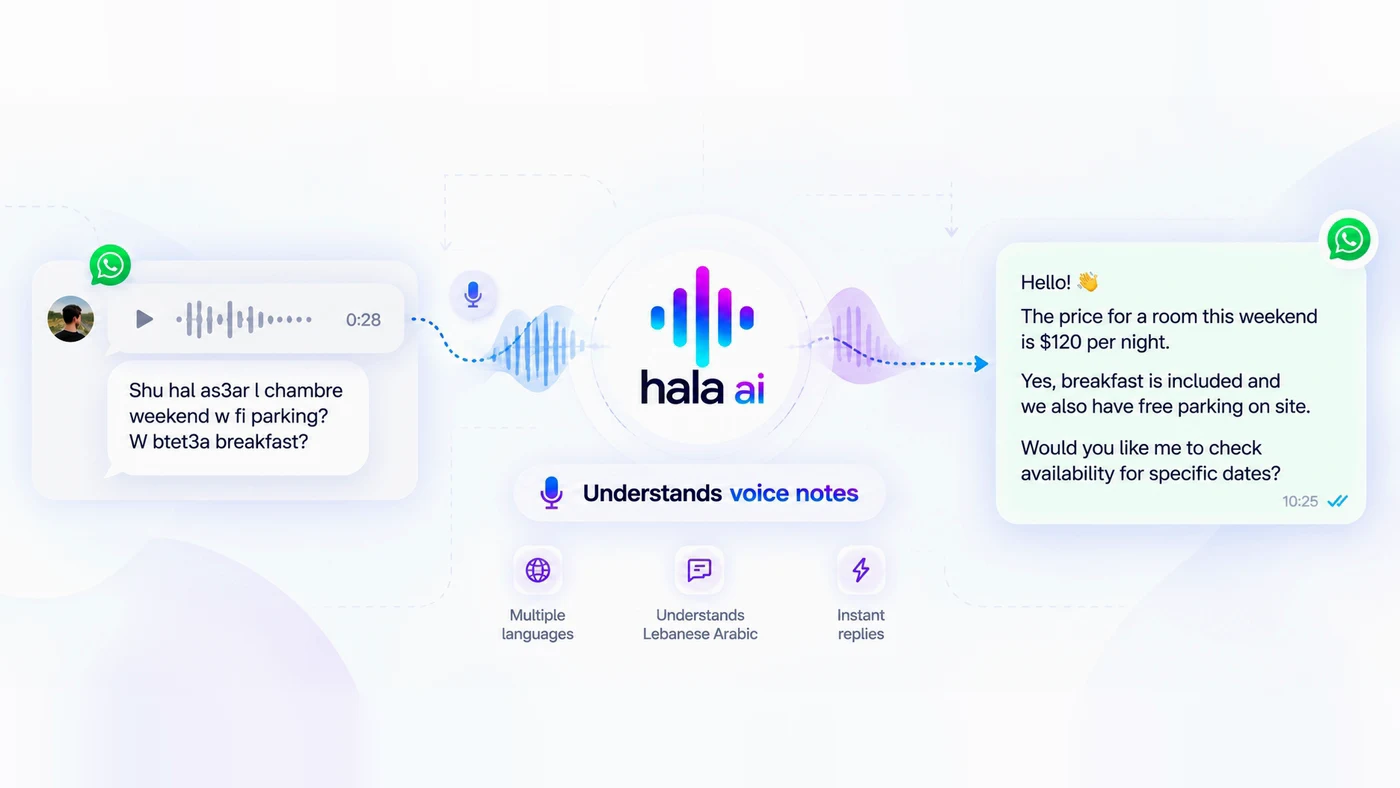

In short: Yes. When a customer sends a WhatsApp voice note, Hala AI listens to it, understands what was said, and replies in text within moments. It is built for the way people in this region actually speak: Lebanese and other Arabic dialects, English, French, and all three in the same sentence. It checks the language against the ones your business supports, learns your product and brand names, and replies the way that customer normally writes.
A customer is driving. Or cooking. Or simply does not feel like typing.
So they hold the microphone button and talk:
"Shu hal as3ar l chambre weekend w fi parking? W btet3a breakfast?"
One voice note. Three questions. Three languages in twelve words.
For a person on your team, that is an ordinary message. For most automated systems, it is the point where everything stops.
Hala AI is built so that it does not stop there.
Why voice notes matter more than you think
In Lebanon and across the Gulf, voice notes are not an occasional thing. For a lot of customers they are the default.
They are faster than typing. They are easier in Arabic, where many people find speaking far more natural than writing. And they carry tone, which matters when someone is asking for a favour, a discount or an urgent fix.
That creates a real problem for any business that automates its WhatsApp.
An assistant that only reads text has two options when a voice note arrives: ignore it, or reply with "Sorry, I can't listen to voice messages. Please type your question."
Both tell the customer the same thing: you are talking to a machine, and it is not listening.
Some customers will retype. Many will not.
So, can AI really understand a voice note?
Yes. And for Hala, a voice note is just another message.
Here is what happens when one arrives on WhatsApp:
Voice note arrives → Hala listens → understands what was said → checks your business knowledge → replies in text
The customer sees their voice note marked as played and sees Hala typing, exactly as they would with a person. A moment later they have an answer:
"Hello! 👋 The price for a room this weekend is $120 per night. Yes, breakfast is included and we also have free parking on site. Would you like me to check availability for specific dates?"
All three questions answered, from one recording.
From there the conversation carries on however the customer likes. They can send another voice note, type, send a photo, or mix all three. Hala keeps the thread.
Accents, dialects and the way people really speak
This is the part most speech technology gets wrong.
What English speakers call an "accent" is, in Arabic, usually a full dialect. Lebanese Arabic differs from Gulf Arabic in vocabulary and grammar, not only in pronunciation. And none of them is the formal Arabic that most software is trained on.
Then there is how people actually talk in this region, which is rarely in one language at a time.
A single sentence can move from Arabic to English to French and back. Linguists call it code-switching. Everyone else calls it Tuesday.
The voice note at the top of this article is a good example:
- "Shu hal as3ar" is Lebanese Arabic: what are the prices
- "chambre" is French: room
- "weekend", "parking" and "breakfast" are English
Hala is built to handle that as one message with one meaning, not three broken fragments.
It works with spoken dialects including Lebanese, Levantine, Gulf, Egyptian, Iraqi and Maghrebi Arabic, alongside English and French. We wrote about why this is so difficult, and why so many systems fail at it, in Why Most AI Voice Agents Fail in Arabic.
Four things Hala does to get voice notes right
Understanding speech is not one step. It is several small safeguards working together.
1. It checks the language before it answers
Short or noisy recordings are the classic failure case for speech recognition. A five-second clip in Arabic can be misheard as a completely different language, and an assistant that trusts the result will reply in that language.
Hala knows which languages your business supports. If a voice note appears to be in a language outside that list, it treats that as a mistake rather than a fact, and listens again in your primary language.
The customer speaks Arabic. The reply is not in Spanish.
2. It learns the names your customers say
Generic speech systems stumble on exactly the words that matter most to a business: your product names, your brand names, your menu items.
An English product name dropped into the middle of an Arabic sentence is especially easy to mishear.
In Hala, you can add those words once, along with the ways customers tend to say them. Hala uses the list to hear the names correctly, and to correct one that was misheard before it answers. The same list is used on phone calls.
3. It replies the way that customer writes
Here is a subtle problem.
Speech is written down in Arabic letters. But many customers who speak Arabic do not text in Arabic letters. They write in Arabizi, the Latin-letter Arabic full of 3s and 7s that is standard on WhatsApp.
If an assistant replies to a voice note in formal Arabic script, to someone who has only ever typed "kifak" and "3a rasi", it feels wrong.
Hala looks at how the customer has actually typed earlier in the conversation and replies in that style. If they write in Arabic script, the reply is in Arabic script. If they write in Arabizi, the reply is in Arabizi.
4. It knows it is listening, not reading
People do not speak the way they write. Voice notes have false starts, filler words, half sentences and the occasional misheard word.
Hala treats a voice note as speech. It responds to what the customer meant, and does not quote their words back to them or get stuck on a slip of the tongue.
What Hala can do with what it hears
Understanding the voice note is only useful if the answer is good.
Because a voice note goes through the same brain as a typed message, everything Hala can do in text it can do in response to speech:
- Answer questions from your business knowledge: prices, hours, location, policies
- Look up live information, such as order status or stock from your Odoo system
- Take a booking or an appointment request
- Collect the details your team needs before they step in
- Hand the conversation to a person when a customer asks for one
A customer can ask for a price by voice, send a photo of the product they mean, and confirm by text. It is one conversation.
And your team is never in the dark. Every voice note stays in the conversation in your inbox, playable, with the text of what was said next to it, so anyone who takes over can see exactly what the customer asked.
Where the limits are
No speech technology is perfect, and it is better to be clear about that.
A voice note recorded next to a generator, in heavy traffic, or with several people talking at once will be harder to understand, for a person and for an AI.
Very long, wandering messages that cover many unrelated topics are harder than short, direct ones.
When a recording really is unclear, the right response is to ask, not to guess. Hala can ask the customer to repeat or type the part it did not catch, and your team can step in at any point.
Two more practical notes:
- Replies are in text. Hala listens to voice notes and answers in writing, which customers can read at a glance.
- Voice notes are supported on WhatsApp. That is where the vast majority of them are sent.
If you want Hala to actually speak with your customers, that is what the AI voice agent does on phone calls.
Why this matters for your business
Every channel has a moment where automation usually breaks. On WhatsApp, the voice note is that moment.
A customer who has just recorded thirty seconds explaining what they need does not want to be told to type it again. They want an answer.
When the assistant understands the voice note:
- The customer gets a reply in seconds, in their own language
- Nobody on your team has to stop and listen to recordings one by one
- After-hours voice notes are answered instead of piling up until morning
- Customers who prefer speaking are served as well as those who prefer typing
For hotels, restaurants, clinics, retailers and any business in Lebanon, the UAE or Saudi Arabia whose customers live on WhatsApp, it removes one of the last reasons a conversation needs a human just to get started.
It is part of what separates a WhatsApp AI agent from a scripted menu: it meets customers the way they already communicate, instead of asking them to adapt.
FAQ
Can Hala AI understand WhatsApp voice notes?
Yes. When a customer sends a voice note on WhatsApp, Hala AI listens to it, understands what was said and replies in text, usually within moments, using your business's own information.
Can Hala AI understand voice notes in Lebanese Arabic?
Yes. Hala is built for spoken Arabic dialects, including Lebanese, Levantine, Gulf, Egyptian, Iraqi and Maghrebi Arabic, as well as English and French, rather than only formal Modern Standard Arabic.
What if the customer mixes Arabic, English and French in one voice note?
That is how many customers in Lebanon and the Gulf naturally speak, and Hala handles it as a single message. A sentence that moves between languages is understood as one question.
Does Hala AI reply with a voice note?
No. Hala listens to voice notes and replies in text. For spoken conversations, Hala's AI voice agent answers phone calls and speaks with callers directly.
Will it recognise my product and brand names?
You can add your product, brand and menu names to Hala, along with the ways customers usually say them. Hala uses that list to hear those names correctly in voice notes and on calls.
What happens if the voice note is unclear or noisy?
Hala checks the detected language against the languages your business supports and re-listens if something looks wrong. If a recording is still too unclear to act on, Hala can ask the customer to repeat or type it, and your team can take over the conversation at any time.
Can my team hear the original voice note?
Yes. The voice note stays in the conversation in your Hala inbox, where your team can play it and read the text of what was said.
Which channels support voice notes?
Voice note understanding is available on WhatsApp. Hala AI also works across Instagram, Facebook Messenger, website chat and phone calls. See the messaging product for the full picture.
Let your customers talk
Your customers are already sending voice notes.
Make sure someone is listening.
Book a demo and send Hala AI a voice note in your own dialect.
Related articles